

Artificial intelligence in water needs better foundations, not bigger promises
Published: 6 November 2026
With pressure growing in the water sector regarding asset health evidence, assurance, and regulatory confidence, the real danger is no longer just fragile foundations, but those foundations being given the appearance of fluency and confidence through artificial intelligence (AI).
The value of AI in water will not come from masking weak evidence. It will come from using data assertively, referenced against clearly defined challenges, and with the right operational and governance foundations in place. This will make evidence more consistent, usable and defensible. In complex and heavily regulated environments, such distinctions are going to be the key difference between expensive illusion and credible progress.
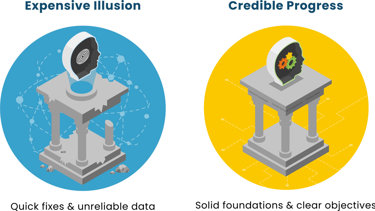
The water sector is not looking at AI in a vacuum. It is doing so at a time when expectations around asset health evidence, data consistency, and assurance requirements are increasing sharply. The immediate opportunity with AI is creating value by using it to improve the quality of asset health evidence to improve business planning confidence and regulatory submission readiness.
Stop treating AI as the strategy
Too often, organisations become captivated by the technology itself and move too quickly past the harder questions. What exactly is broken today? Where is effort being wasted? Which decisions are being held up, and where in the process are those delays happening? Where is confidence lacking? AI should be positioned as an enabler, not a strategy.
This is not about being resistant to, or anti-AI, but anti-vagueness: a power drill is useful only when you know what you are building, where to drill, and whether the wall will hold. Enthusiasm for AI adoption is purposeful only when attached to a specific problem, a measurable outcome, and a realistic implementation path.
AI can make weak foundations look stronger than they are
AI does not magically correct poor source data, align inconsistent asset definitions or hierarchies, standardise ad-hoc data collection practices, reconcile inconsistent condition grades or work order coding, or clarify unclear ownership. It scales them. Data quality, provenance, lineage, and compliance are not administrative side issues; they are central to whether AI can be trusted at all.
Experience across enterprise AI adoption points to the same issue: as adoption rises, unresolved weaknesses in governance, literacy, and data discipline become more exposed, not less. When bad inputs meet impressive AI, the output may deliver a surface layer that may just look polished enough to escape sustained challenge – which is precisely what makes it risky.

In regulated environments, looking ‘credible’ can be a serious risk
The gap between operational reality and slick – yet fundamentally shaky – AI output can have serious consequences.
In regulated sectors where decisions, submissions, or investment cases must withstand scrutiny, the danger is not merely technical error; it is misplaced confidence in something that looks credible, coherent, and assured. If an AI-assisted output is based on incomplete, stale, or inconsistently interpreted source data, it may still present itself with fluency and authority. That can distort assurance, weaken challenge, and create downstream regulatory or operational consequences precisely because the output appears polished enough to persuade.
Responsible AI in these contexts depends on transparency of inputs, explainability of logic, and visible human accountability around the final judgement.
Water sector asset health data is the ‘must act now’ arena
Asset health data is where the AI readiness debate becomes real because it sits at the intersection of regulatory expectation, operational reality, field collection discipline, and emerging analytical opportunity.
The UK water sector is under growing pressure to strengthen understanding of asset health, with expectations around asset datasets and supporting management systems becoming more prominent as the regulatory picture develops. At the same time, sector commentary on AI adoption keeps circling the same challenge: water companies are often rich in data but poor in usable, connected insight. That makes asset health a compelling proving ground for a more mature AI conversation because it forces the question back to basics: do we trust the underlying data, and can we act on the resulting insight with confidence?
Partnership model: engaged client, domain expertise, and platform capability
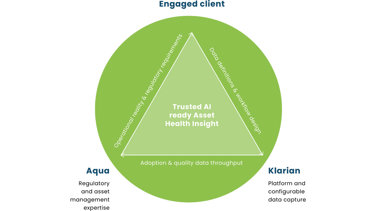
Asset health is a natural test bed for applied AI, but what delivery model makes that credible in practice? The answer is not technology alone, but a partnership that combines domain expertise, platform capability, and client ownership.
That is the logic behind our strategic partnership with Klarian in this space. We define the problem, data standards, and assurance expectations; Klarian provides the configurable platform and technical environment; the client owns the source processes, data quality culture, and decision accountability. AI creates value when it sits on top of clear standards, reliable workflows, and accountable judgement.
AI readiness checklist
A defined use case: A specific business or regulatory problem, not a generic desire to innovate.
Agreed data standards: Clear definitions, thresholds, formats, and ownership for the data being collected.
Defined evidence acceptance criteria: Explicit thresholds for what constitutes complete, credible, and decision-ready evidence.
Reliable capture processes: Practical workflows in the field and office that make good-quality data the default.
Traceability: The ability to track outputs back to source data, logic, and decision points.
Audit trail: A clear record of what data, rules, interventions, and decisions shaped the final output.
Governance: Clear accountabilities for review, challenge, sign-off, and continuous improvement.
Human-in-the-loop assurance: AI used to support better decisions, not bypass professional responsibility.
Feedback loops: Mechanisms to learn from errors, refine rules, and improve model usefulness over time.
Focus less on AI theatre, more on AI readiness
The organisations that will realise continuing value from AI will not be the ones making the loudest claims, but the ones quietly putting the right conditions in place. AI is not a shortcut around the hard work of good asset management, good data, and good governance; it is a force multiplier for organisations that have built those essentials well.
Where the basics are weak, AI will expose and amplify the problem. Where they are strong, AI can help turn fragmented data into timely, credible, decision-ready insight.
That matters even more in the water sector as the industry moves towards the PR29 business planning cycle. AI will not reduce the need for assurance; it will raise the bar for it, increasing scrutiny of how evidence has been assembled, interpreted, and presented.
The near-term opportunity is not in AI itself, but in using it within the context of good data design and stronger assurance to make asset health evidence more consistent, scalable, and decision ready. That is where the combination of client ownership, our regulatory expertise, and Klarian’s platform creates practical and lasting value.
In the run up to PR29, the question is not who is using AI, but who can use it in a way that is evidence-based, assured, and defensible. That is where real advantage will sit.
Key takeaways
Organisations get the best results from AI when they start with a defined operational problem rather than a vague ambition to “do something with AI”.
In regulated sectors, what looks like credible or polished AI output can be more dangerous than obviously poor output because it can create false confidence.
The route to value is not AI-first, but foundation-first: data quality, traceability, governance, domain expertise, disciplined implementation, and human-in-the-loop assurance.
The most credible AI deployments are, and will be, those where every insight can be traced back to robust inputs, clear rules, and accountable human oversight.
Latest resources
 Insights
AI in water needs better foundations, not bigger promises
 Insights
Beyond the badge: How maturity assessments can turn conformance into capability
 Insights
Reflecting on final determinations by the CMA on 2024 price review and looking ahead to PR29
 Insights
Navigating reform to regulations on sewage sludge
Here to solve your biggest challenges and grow sustainable value
Our expert consultants are available to broaden your thinking, lead transformation, and help you achieve successful outcomes.
Contact our experts